
Do You Need a Stud Finder to Hang Pictures and Shelves?
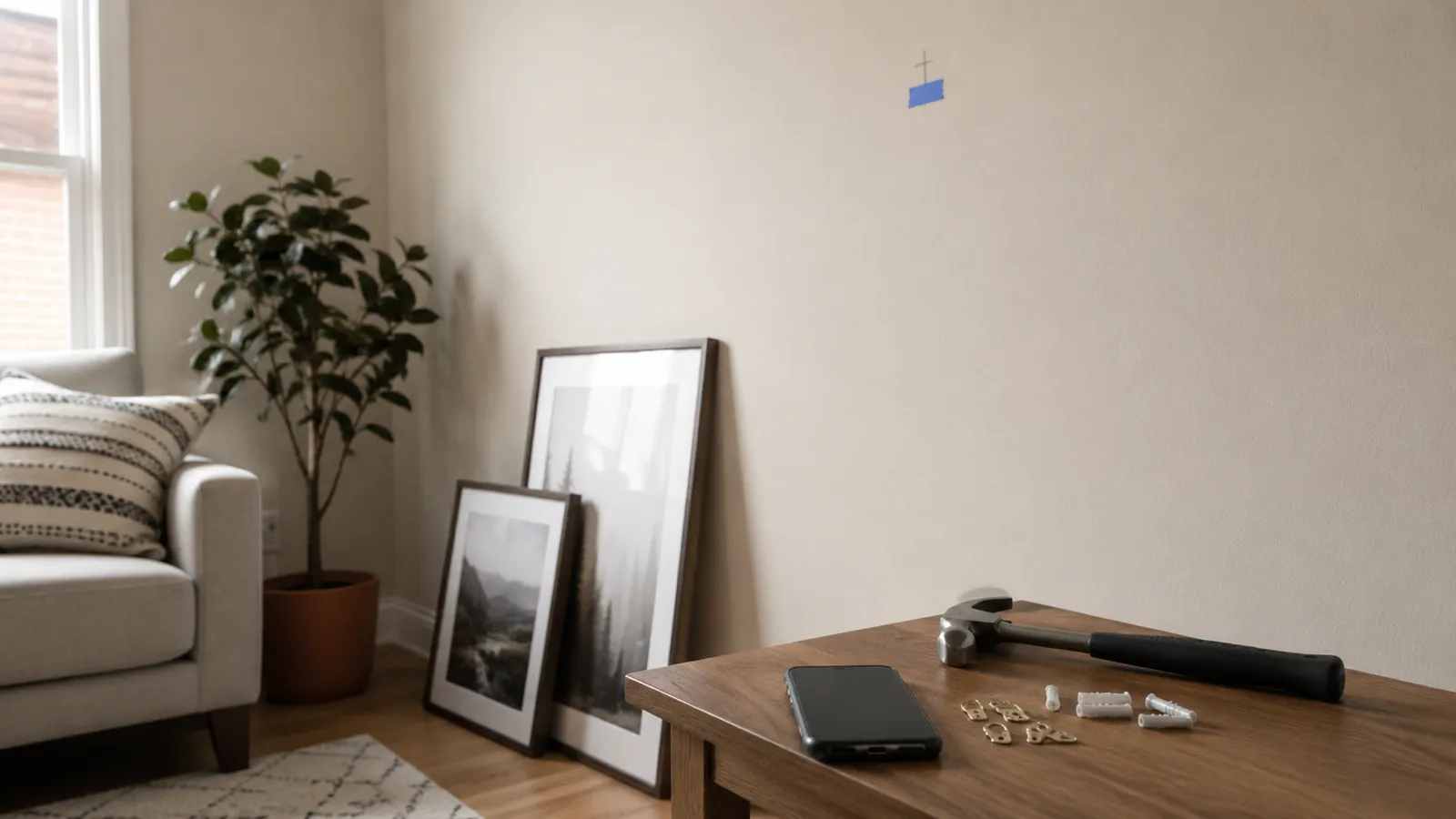
Do you need a stud finder to hang pictures?
For the average framed picture: no. Drywall with the right hanger holds far more than most people give it credit for, and a frame under about 20 lb (9 kg) — which is nearly every photo, print, and canvas in a normal house — hangs happily on a picture hook or a small anchor driven anywhere on the wall. You get to put the picture exactly where it looks right, not where the framing happens to be.
That’s the opposite of the advice we give for TVs, and it’s not a contradiction — it’s physics. A flat frame loads its fastener straight down. A TV on an arm, or a loaded shelf, pries its fasteners outward. Same wall, completely different problem. This post is about where that line actually sits.
How much weight can drywall hold without a stud?
The honest answer: it depends almost entirely on the fastener, and every number below is a manufacturer-rating-style figure, not a promise. Real walls have patched spots, old holes, and 3/8-inch board where you expected 1/2-inch. Treat ratings as a ceiling and stay well under them.
Working roughly from light to heavy, in sound 1/2-inch drywall:
- Adhesive strips are rated by their maker up to ~15–20 lb (7–9 kg) for a large multi-strip set, on smooth painted surfaces, applied exactly per the instructions.
- Picture hooks (the angled-nail kind) are commonly sold in ratings from ~10 up to ~50 lb (4.5–23 kg) depending on size and nail count.
- Plastic expansion anchors are good for roughly 10–25 lb (4.5–11 kg).
- Self-drilling (threaded) drywall anchors run ~40–75 lb (18–34 kg) by rating.
- Toggle bolts and snap-toggle anchors are rated higher still — often north of 80 lb (36 kg) in 1/2-inch board — and are the strongest thing you can put in drywall without framing behind it.
Here’s the table that answers most hanging questions in one look:
| Item | Typical weight | Stud needed? | Recommended fixing |
|---|---|---|---|
| Small frame (up to ~11×14) | under 5 lb (2 kg) | No | Adhesive strip or small picture hook |
| Large framed print or canvas | 5–15 lb (2–7 kg) | No | Picture hook or plastic anchor |
| Heavy framed mirror | 20–50 lb (9–23 kg) | Recommended | Toggle bolts; screw into stud if one lines up |
| Bracket shelf, lightly loaded | 10–20 lb (4.5–9 kg) total | Not strictly | Self-drilling anchors or toggles |
| Bracket shelf, loaded (books, dishes) | 30–60 lb (14–27 kg) total | Yes | Screw into stud, at least one bracket |
| Floating shelf | almost any | Yes | Screw into stud — leverage rules here |
| Anything above a bed or crib | any | Yes, or rated toggles | Screw into stud for peace of mind |
Notice the pattern: the “stud needed” column doesn’t track weight cleanly. A 40-lb mirror can live on toggles while a 15-lb floating shelf wants a stud. That’s the part worth understanding.
Shear vs pull-out: why a shelf is different physics from a frame
Drywall has a strong direction and a weak direction, and every hanging decision comes down to which one you’re loading.
Shear is the straight-down load. A flat frame hangs against the wall, and gravity pulls its hook down, parallel to the wall surface. The fastener is being asked to resist sliding, and the drywall behind it is compressed rather than torn. This is drywall’s strong direction — it’s why a thin angled picture-hook nail can carry a rating of 30 lb (14 kg) in half-inch board.
Pull-out (tension) is the outward load. A shelf sticks out from the wall, and everything on it sits at the end of a lever. The bottom of the bracket pushes into the wall while the top screws are pried out of it — and the further the load sits from the wall, the harder the pry. Drywall resists pull-out with nothing but the crumbly gypsum around the fastener. This is its weak direction, and it’s where anchors quietly wallow out over months before letting go all at once.
That’s the whole answer to the riddle in the table: a 15-lb (7 kg) mirror loads its hook in shear and doesn’t strictly need a stud, while a 15-lb floating shelf — whose hidden bracket is one long lever with no visible support — concentrates a multiplied pull-out force on a few fasteners and absolutely wants one. Weight isn’t the question. Direction is.
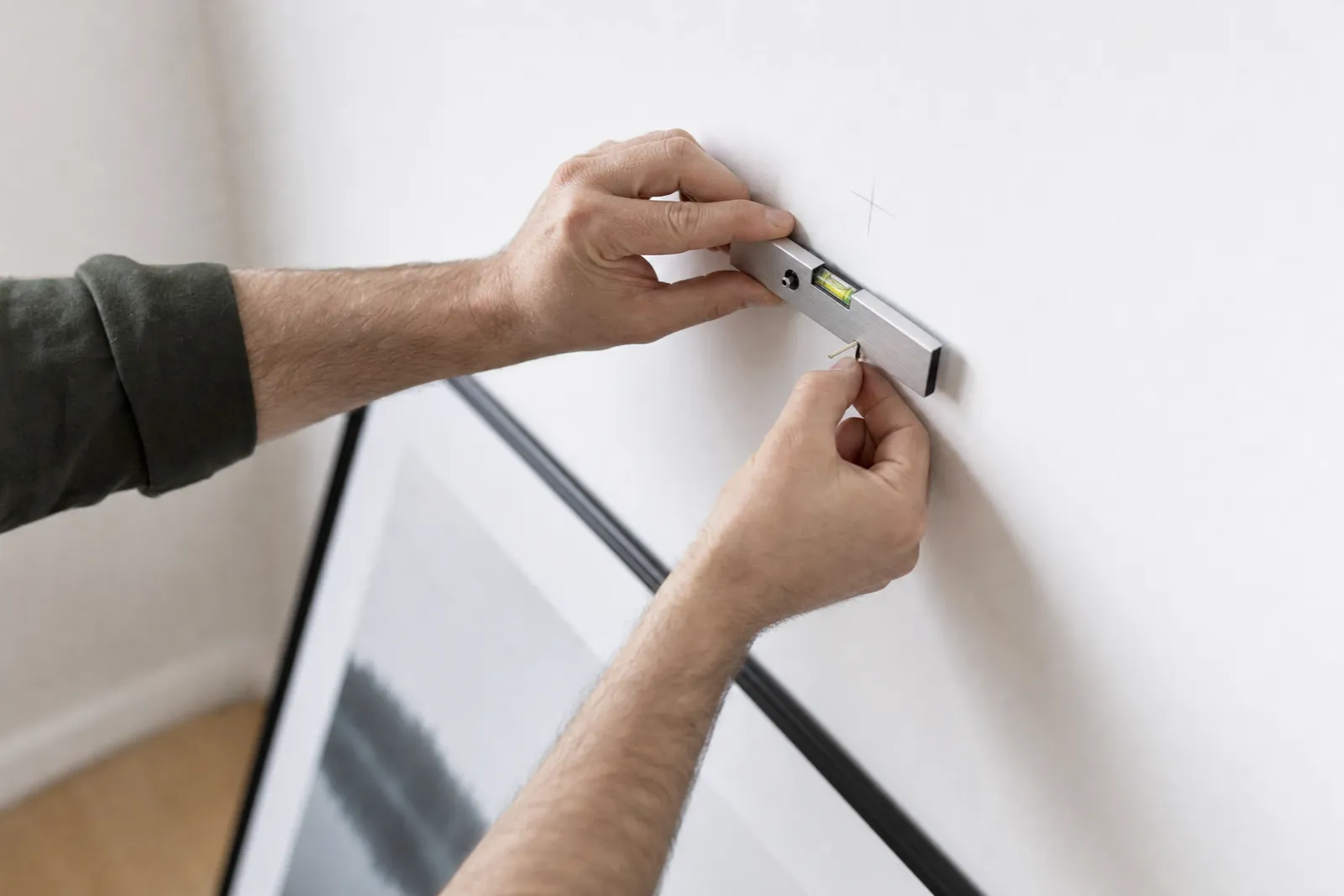
When you do want a stud
The cases where we’d stop eyeballing and go find framing:
- Heavy mirrors, 30 lb (14 kg) and up. Toggles can carry them by rating, but a big mirror is glass over walkways and furniture. A stud costs nothing extra if one lines up near your spot.
- Any shelf you’ll load. Bookshelves are the classic failure — books add up to 20–40 lb (9–18 kg) faster than you’d think, and every one loads the brackets in pull-out. Land at least one bracket on a stud.
- Floating shelves, almost always. The concealed bracket is pure leverage. Most floating-shelf makers spell it out in the instructions: into studs, or steep derating on anchors.
- Anything above a bed, crib, or sofa. This is a falling-object call, not a strength call. A frame that would be a shrug over a hallway is a different decision over a sleeping kid. Use a stud or a properly rated toggle, and be honest about the anchor’s condition.
- Anything on a bracket or arm. Sconces, plant arms, wall-mounted lamps — same cantilever math as shelves. And once the thing on the arm is a screen, you’re in different territory entirely: see do you need a stud finder to mount a TV, where the answer flips to yes.
Rental-friendly hanging, in order of hole size
Renters hang more pictures than anyone and patch more walls at move-out. The escalation that keeps your deposit:
- Adhesive strips — zero holes. Respect the maker’s rating (~15–20 lb / 7–9 kg for a large set), the surface prep, and the one-hour wait before hanging. They fail on textured walls and fresh paint, so test somewhere hidden first.
- Picture hooks — one thin nail hole, invisible after a dab of spackle. This is the workhorse of picture hanging hardware and the right default for frames the strips can’t take.
- Plastic anchors — a 1/4-inch hole that needs a real patch. Fine if your lease allows it; think twice if it doesn’t.
- Toggles and self-drilling anchors — 1/2-inch-plus holes. These are homeowner hardware. In a rental, anything heavy enough to need them is heavy enough to deserve a conversation with the landlord — or a stud, which patches down to a single screw hole.
When you need the stud, finding it takes seconds
None of this requires buying anything. Your phone’s magnetometer can detect the screws that fasten drywall to every stud, which is exactly what a stud finder app does: sweep the phone across the wall, watch the reading spike at each fastener, mark it in pencil. On standard drywall it puts you within about an inch, and a 1/16-inch pilot hole confirms the center — wood shavings mean you’re on it.
The usual honest caveats apply. Plaster and lath confuse magnetometer readings, metal-mesh corners throw false positives, and tiled surfaces are their own story — covered in do stud finders work through tile. But for the wall behind your gallery arrangement or your future bookshelf, it’s the fastest route from “somewhere around here” to a pencil mark you can drill.
So: hang the pictures wherever they look right — the drywall’s got them. Save the stud for the mirror over the dresser, the shelf that’ll actually hold books, and anything hanging over a pillow. And when that job comes up, download the app — it finds the stud in seconds, free to try, ad-free, no signup to start.
Frequently asked questions
How to Find Studs in Plasterboard Walls (UK & AU Guide)
Find timber behind plasterboard with your phone, a magnet, or a stud wall finder — and how to spot a dot and dab wall before you drill into nothing.
How to Find Studs Without a Stud Finder: 7 Ways That Work
Seven real ways to find a wall stud without a stud finder — knock test, outlets, magnets and the sensor already in your phone. What works and what doesn't.
See behind the wall,
now in your pocket.
Stud Finder turns your phone into a precision wall scanner. Know where the studs, screws and pipes are before you drill.
Download the App