
Online Stud Finder: Is There One That Works in a Browser?
Looking for an online stud finder with no download? Why a web page can't read your phone's sensor, what those sites do, and the fastest free options.
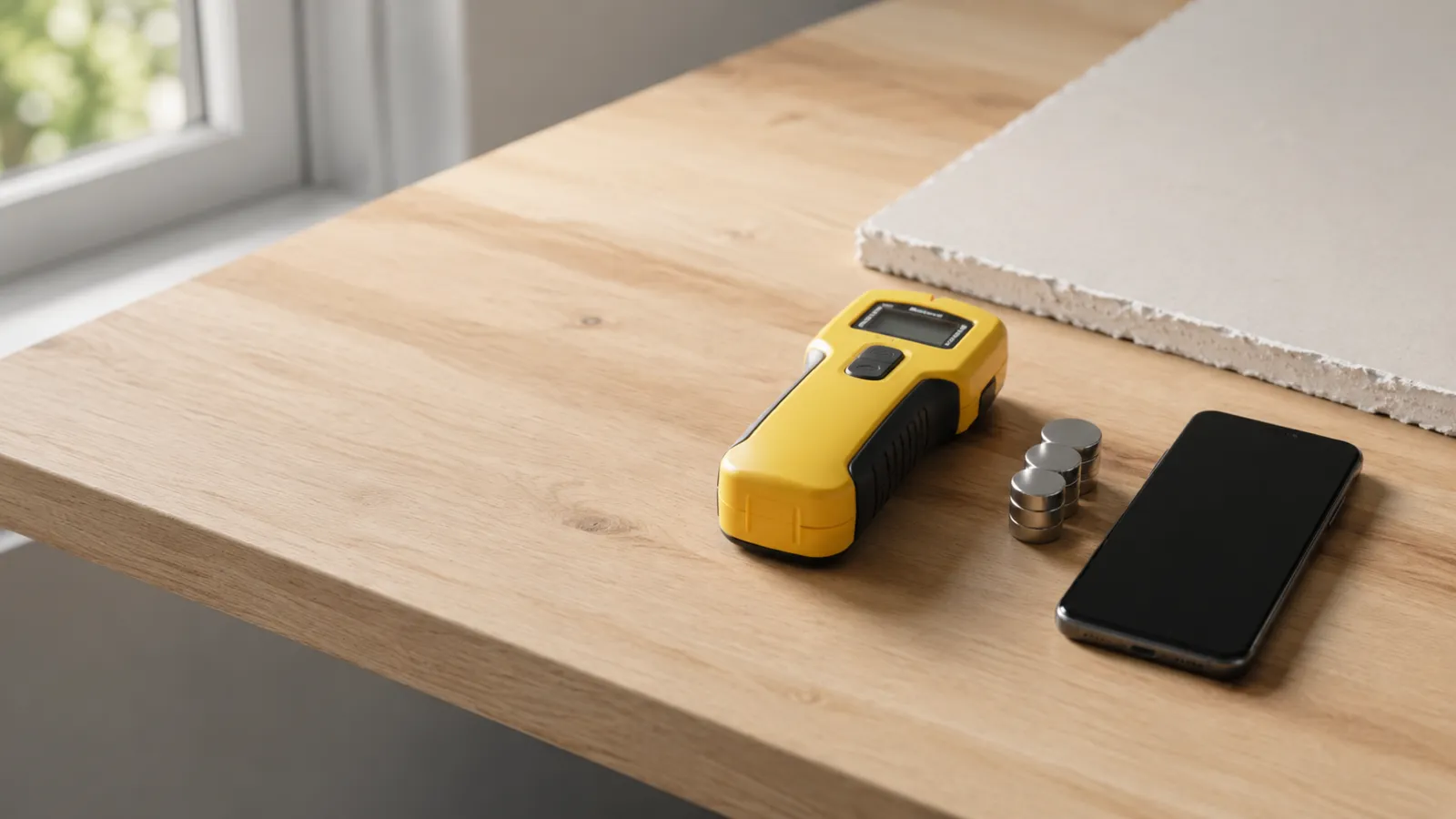
A stud finder is a tool that locates the framing behind a finished wall. Slide it across the surface and it signals — with a light, a beep, or an on-screen spike — when it passes over a stud, the vertical board the drywall is fastened to. That’s the entire job: it tells you where the solid wood is, so your screw goes into structure instead of into half an inch of gypsum and then empty air.
Most stud finders are palm-size plastic devices that run on a battery. The simplest ones are just a housed magnet with no electronics at all. And one version isn’t a device at all — it’s an app that turns the phone already in your pocket into the sensor. All of them answer the same one-dimensional question: stud here, or no stud here?
You can’t appreciate the tool without knowing what it’s hunting. A stud is a vertical framing member — in most US homes, a 2x4 or 2x6 board — that forms the skeleton of a wall. Studs run floor to ceiling, and in standard construction they’re spaced 16 or 24 inches on center, meaning the distance from the center of one stud to the center of the next. The drywall you see is a thin skin screwed onto that skeleton.
That skin is the problem. Standard drywall is about 1/2 inch of compressed gypsum — chalk, essentially. A screw driven into drywall alone is gripping chalk dust, and anything with real weight will eventually crater out of it. A screw driven into the stud behind it is gripping an inch and a half of solid lumber that’s nailed into the frame of your house. Same screw, completely different outcome. The stud finder exists to make sure you get the second one.
The purpose of a stud finder is finding safe anchor points before you mount something on a wall. In practice that means:
A stud finder is not a general wall scanner. Basic models don’t map pipes or wires, and none of them show you a picture of the wall’s contents — for what each detection method can and can’t see, read how does a stud finder work.
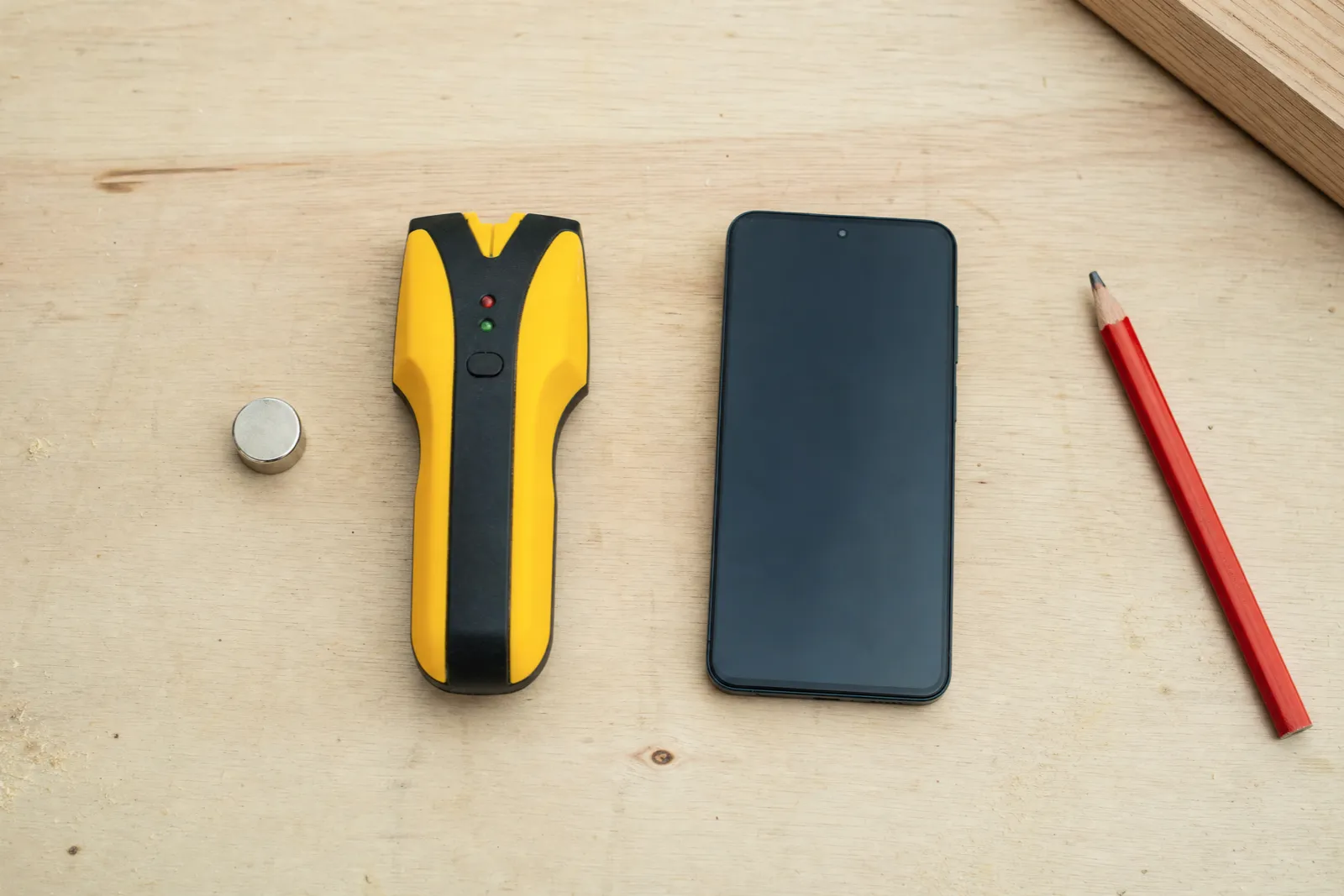
Every stud finder on the market is one of four kinds. Here’s the one-line version of each — the full technology breakdown lives in the how-it-works post linked above.
| Type | How it signals | Best for |
|---|---|---|
| Magnetic | A magnet tugs toward the steel screws in each stud | Zero-battery simplicity on standard drywall |
| Capacitive (electronic) | Lights/beeps on the density change at a stud | The everyday hardware-store choice for wood-framed drywall |
| Radar / imaging | Renders an approximate map of studs, pipes, and wires | Renovation work where you need to know what else is in the wall |
| Phone app | Your phone’s magnetometer spikes over each fastener | Finding studs with hardware you already own, free to try |
They range from a $5 magnet to a few hundred dollars of imaging gear, but on an ordinary drywall wall they all end at the same place: a pencil mark over a stud.
Honestly: no. People hung heavy things on walls for decades before stud finders existed, and the old methods still work.
Every one of these gets you a probable stud. The reason stud finders exist is the gap between probable and certain: when you’re about to drive a lag bolt through a $400 TV mount, “I think there’s a stud here” is a nervous place to be. A finder — any of the four types — converts the guess into a confirmed location in a few seconds, and lets you verify the 16-inch rhythm across the whole wall instead of trusting a single knock.
The cheapest way to close that gap costs nothing to try: a stud finder app uses the magnetometer your phone already has to detect the screws in each stud. It’s the same physics as the $5 magnet, with a live reading on screen instead of a tug in your fingers — you can see exactly how the app works before you try it. If it turns out you scan walls every weekend, or you need to see pipes and wires, that’s when paying for dedicated hardware starts to make sense. Which brings up the honest limits: apps and magnets want drywall over wood framing — or steel studs, which they read directly. On plaster or masonry, every consumer tool gets less trustworthy, and fastener-based tools most of all.
A stud finder is a locator, not a luxury — a tool that answers one question, where is the solid wood behind this wall, and answers it well. You need that answer any time something heavy is going up: a TV, a shelf run, a grab bar, anything past the weight a drywall anchor can honestly carry. Whether you get the answer from a knock, a magnet, a beeping gadget, or the phone in your pocket matters much less than actually getting it before you drill.
Start with the free trial: mark your studs with the app, then follow how to use a stud finder to confirm the spacing and put your screws where the structure is.
A stud finder is a handheld tool that locates the wooden or steel framing members — studs — hidden behind a finished wall. It signals with a light, a beep, or an on-screen reading when it passes over a stud, so you can anchor screws into solid structure instead of hollow drywall. It can be a dedicated device or an app that uses your phone's sensors.
A stud finder is used to find safe anchor points before mounting anything heavy on a wall. Drywall alone holds very little weight, so TVs, shelves, cabinets, mirrors, and grab bars need screws driven into the studs behind it. The tool marks where those studs are without drilling test holes.
No — you can find studs by knocking, using a strong magnet, or measuring 16 inches from an outlet, since boxes mount to studs. A stud finder just does the same job faster and with more certainty, especially when the wall gives ambiguous knocks. A phone app you can try for free is the middle ground.
A stud is a vertical framing member, usually a 2x4 or 2x6 board, that forms the skeleton of a wall behind the drywall. In US construction studs are typically spaced 16 or 24 inches on center. They carry the wall's load, which is why screws anchored into a stud hold far more weight than screws in drywall alone.
A typical stud finder is a palm-size plastic device you slide flat against the wall, with LED lights or a small display and a beep that fires over a stud. Magnetic versions are even simpler — a small block with a magnet inside. The app version has no hardware at all; it is just your phone showing a live sensor reading on screen.

Looking for an online stud finder with no download? Why a web page can't read your phone's sensor, what those sites do, and the fastest free options.

Will a stud finder work through tile? Magnets and magnetometer apps do; capacitive finders mostly don't. How to find studs behind tile — and when to cheat.
Stud Finder turns your phone into a precision wall scanner. Know where the studs, screws and pipes are before you drill.
Download the App